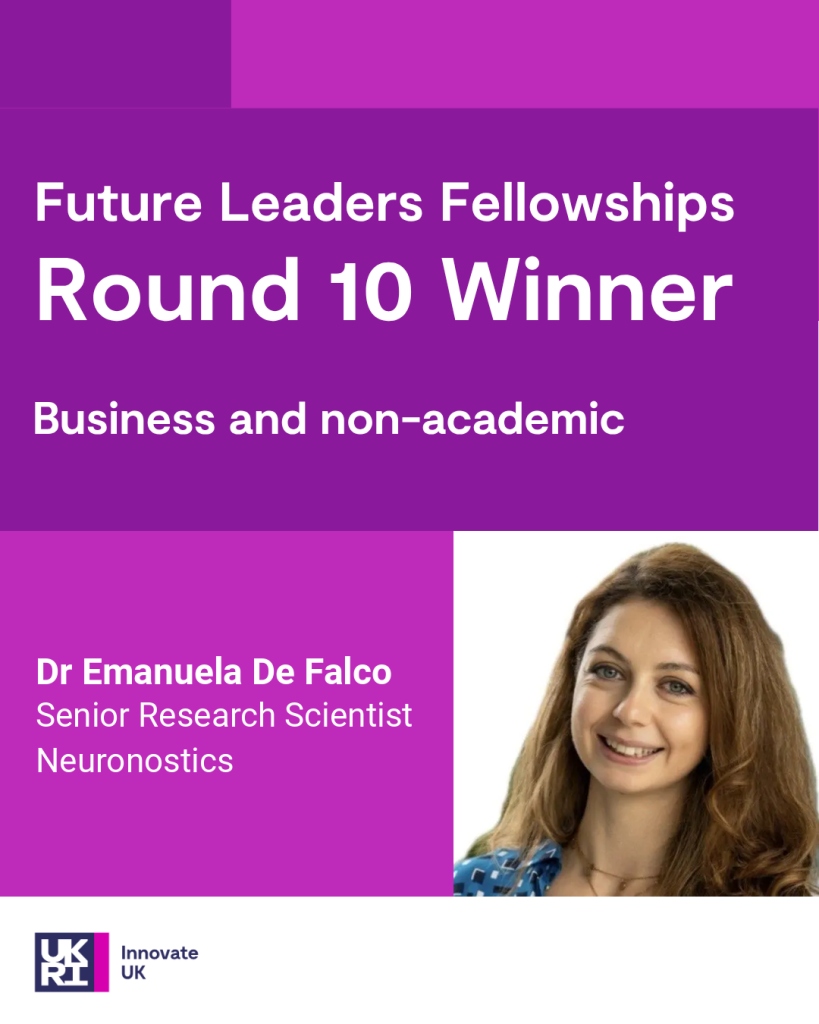
Dr Emanuela De Falco, Senior Research Scientist at Neuronostics, has been awarded a UKRI Future Leaders Fellowship. Her four-year, £2M project will develop EEG-based tools to predict recovery and the risk of complications after traumatic brain injury (TBI). The Fellowship is hosted at Neuronostics and is due to start on 1 November 2026.
Why predicting recovery matters
More than a million people in the UK have a traumatic brain injury each year, most often from falls, sport or road accidents. Many recover fully. Some develop long-term problems, from fatigue and mood changes to seizures or difficulties with memory and concentration. TBI is also a major cause of acquired epilepsy, known as post-traumatic epilepsy.
At present, clinicians have few ways to tell early on who will recover well and who will not. The Glasgow Coma Scale and brain scans are essential for immediate care, but they say little about how an individual will recover over the following months. That uncertainty makes it hard to plan care, reassure patients and families, and direct specialist support to the people who need it.
The approach: EEG and models of brain networks
EEG is a safe, low-cost test that is already used routinely in hospitals. Emanuela will apply mathematical and computational methods to standard EEG recordings to find patterns of brain activity that are not visible to the eye. The aim is measures that predict how a patient is likely to recover, and that clinicians can interpret.
The work runs in three connected strands:
- Computational models that link EEG to the changes in brain networks that follow an injury. These build on the modelling framework behind BioEP, our digital biomarker for epilepsy.
- A study of existing intensive-care EEG and clinical data from people with moderate or severe TBI, looking first for markers that predict early seizures and post-traumatic epilepsy.
- A new study of people with mild TBI, recording EEG after the injury and following their recovery over a year, to look for early signs of delayed or incomplete recovery.
Findings from each strand feed the others. The longer-term goal is a prototype tool to support clinical decisions after TBI.
Both studies will run with NHS clinicians. People with lived experience of TBI helped shape the project and will continue to guide the study design and how results are shared.
A second condition, and uses beyond the clinic
The Fellowship takes our digital biomarker platform beyond epilepsy for the first time. In epilepsy, BioEP supports diagnosis when routine EEG is inconclusive, and a prognostic version is in development. In TBI, the focus is prognosis: predicting recovery and the risk of complications.
There may also be uses outside the clinic. Compensation claims after road accidents, falls or injuries at work often depend on how badly someone was hurt and how far they are likely to recover. In mild TBI, scans are often normal even when symptoms persist, which makes those effects hard to evidence. An objective, EEG-based measure of brain function and likely recovery could give medico-legal assessments a firmer footing.
Quotes
Dr Emanuela De Falco said: “When I met people with lived experience of TBI while designing this project, I was struck by how much they wanted clearer information and guidance on recovery, particularly on when it is safe to return to everyday activities. This has helped shape my research plans. EEG gives us an affordable way to see how the injured brain is functioning, and through this Fellowship, I hope to turn it into tools that clinicians can use to improve TBI care.”
Professor John Terry, Co-Founder & Managing Director, said: ‘This takes our work beyond epilepsy for the first time. After a brain injury, clinicians have very little to go on when predicting recovery. EEG is already widely used in the hospital, especially in the aftermath of a head trauma. Emanuela is the right person to lead it, and we’re looking forward to seeing her develop as a Future Leader.’
About Emanuela
Emanuela is a computational neuroscientist and data scientist, with degrees in physics and a PhD in bioengineering. She has more than ten years’ experience analysing recordings of brain activity, from single neurons to scalp EEG. Her research career has taken her through the UK, the US and Switzerland, including work with neurosurgical patients on how the brain stores memories and on Parkinson’s disease.
At Neuronostics she works on EEG biomarkers for epilepsy, including research on prioritising follow-up for patients whose routine EEG is inconclusive (Charles, De Falco et al., Epilepsy & Behavior, 2026). She leads our TBI work with Dr. Zahra Amini, who joined in October as Research Scientist.
About the Fellowship and Neuronostics
Future Leaders Fellowships are run by UK Research and Innovation (UKRI) and support researchers and innovators in universities, businesses and other organisations to lead their own programmes. The business and non-academic route is delivered by Innovate UK. Please visit Innovate UK – News to read their full announcement.
Neuronostics enhances neurological care with digital biomarkers, providing objective diagnostic support when traditional EEG analysis is inconclusive. Its UKCA-marked product, BioEP, works with a short routine EEG. The company was founded in 2018 as a spin-out from the University of Exeter and is based in Bristol.