Our Journey in 2025
- National recognition with Professor John Terry elected Fellow of the Academy of Medical Sciences
- International reach presenting BioEP research across Europe and the US
- Clinical progress with large scale adult and paediatric trials underway
- Strategic partnerships supporting US expansion and FDA engagement
- NHS progress with live service evaluation underway
For many people living with suspected epilepsy, the journey to a conclusive diagnosis can be a long and uncertain one. Initial tests are often inconclusive, leading to a stressful waiting period for further investigation and the anxiety of not knowing. At Neuronostics, our work is driven by a single, clear goal: to bring clarity to this process and help clinicians make faster, more accurate decisions for their patients. 2025 has been a pivotal period in this mission, as we have seen our foundational science translate into tangible, real world impact, moving us closer to a future where uncertainty is replaced by clear, actionable insights.
Our pioneering technology, BioEP, sits at the heart of this progress. It is a clinical decision support tool that analyses electroencephalogram (EEG) recordings (which measure the brain’s electrical activity) to identify subtle patterns that may indicate a person’s susceptibility to seizures. By providing this objective data, BioEP empowers clinicians with greater confidence, particularly in complex cases where diagnostic uncertainty is high. This year, the scientific principles behind BioEP have gained significant recognition, strengthening the foundations upon which our clinical and commercial efforts are built.
In a testament to this, our Co-Founder and Managing Director, Professor John Terry, was elected a Fellow of the Academy of Medical Sciences in July. This is one of the highest honours in UK medical science and serves as powerful external validation of his pioneering work in translating complex mathematical models of epilepsy into a tool with real world clinical utility. This was complemented by a Tech Leadership Award from Tech South West, highlighting our successful transition from an academic spinout to a commercial MedTech company.

Our scientific team has also shared our research globally, presenting at the International Epilepsy Congress in Lisbon, the ILAE British Branch Conference in Bournemouth, and the American Epilepsy Society Annual Meeting in Atlanta. These forums are not just about presenting data; they are crucial opportunities to engage with the world’s leading experts, foster collaboration and ensure our work is challenged, refined and remains at the forefront of neurological science.
This strong scientific base is being rigorously tested in the complex reality of clinical settings. We currently have three active clinical trials across the UK, each designed to build the evidence base for BioEP.
The CITADEL study, which has now recruited over 200 patients from 13 first seizure clinics, is assessing how BioEP can improve the diagnostic pathway for those with inconclusive initial EEGs, potentially reducing the long waits for a firm diagnosis.
Meanwhile, the ECLIPSE trial is exploring its role in predicting long term outcomes and guiding treatment planning, a vital step towards more personalised care.
For our younger patients, the OASIS study is validating BioEP’s use in paediatrics, with over 500 records collected from eight sites so far. The results from these studies will be critical in demonstrating the widespread value of our technology.
Encouragingly, a recently completed trial focused on clinician confidence has already shown that BioEP significantly supports decision making in cases of high diagnostic uncertainty, reinforcing its value at the clinical front line where difficult decisions are made every day.

As the evidence for BioEP’s clinical utility grows, so too does its commercial momentum. A landmark achievement this year was the announcement of our strategic partnership with Stratus, a leading provider of EEG services in the United States. This collaboration provides us with access to a vast and diverse dataset of 1,000 EEG recordings, which is crucial for ensuring our algorithms are robust and effective for the diverse US population ahead of our pivotal SOLITAIRE study.

We were also pleased to welcome Stratus CEO, Charlie Alvarez, to our Board, cementing a partnership that is fundamental to our U.S. market entry. This progress was further bolstered by a productive meeting with the FDA’s neurology team in October, where we received positive feedback on our regulatory strategy and our plans for a future De Novo submission, a key step towards bringing BioEP to patients in the United States.

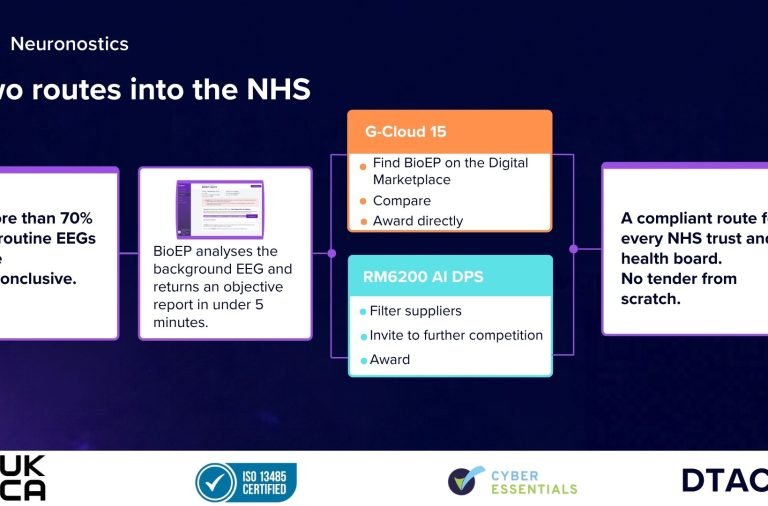
Here in the UK, we are seeing BioEP take its first steps into routine clinical practice. The Royal Wolverhampton NHS Trust has launched a live service evaluation, a project that not only demonstrates the technology’s value but also establishes a scalable model for wider NHS adoption. We are seeing growing interest from other Trusts, a clear signal that the health service is ready for innovative tools that can improve efficiency and patient care.

None of this progress would be possible without our dedicated team and the wider community that supports us. We were proud to be recognised with multiple awards this year, including HealthTech Business of the Year at the SPARKies and Most Transformative HealthTech Company at the OBN Awards.
These accolades are a tribute to the collective hard work and dedication of our entire team, from our scientists and engineers to our clinical and commercial staff. We have welcomed new talent, with Jeremy Andrews joining as Head of Partnerships and Raiyan Sharieff as Quality & Compliance Manager, who both bring invaluable experience to our mission. We also said a fond farewell to Milaana Mainstone, whose exceptional contributions were recognised with a shortlisting for the Women in Tech awards, a reflection of the high calibre of talent we are proud to have at Neuronostics.


Throughout our growth, we have maintained a deep connection to the epilepsy community, working closely with charities such as Epilepsy Action, Young Epilepsy, the Epilepsy Research Institute, and the Voice for Epilepsy. Their insights, and the lived experiences of the people they represent, are woven into the fabric of our work, ensuring that we are building a tool that makes a meaningful difference.

As we look to 2026, our focus is clear. We will be working to complete the SOLITAIRE study and submit the outcomes to the FDA. The finalisation of the OASIS study will pave the way for a paediatric version of BioEP in the UK. We will continue to scale our adoption within the NHS and expand our relationships in the US and the UAE, while deepening our partnerships with pharmaceutical companies to support smarter clinical trials.
Thank you for your continued support, whether as a partner, investor, clinical collaborator or interested observer. Every contribution, conversation and piece of feedback plays a part in this journey. Together, we are building the future of neurological care.
We wish you a restful festive break and an impactful start to 2026.